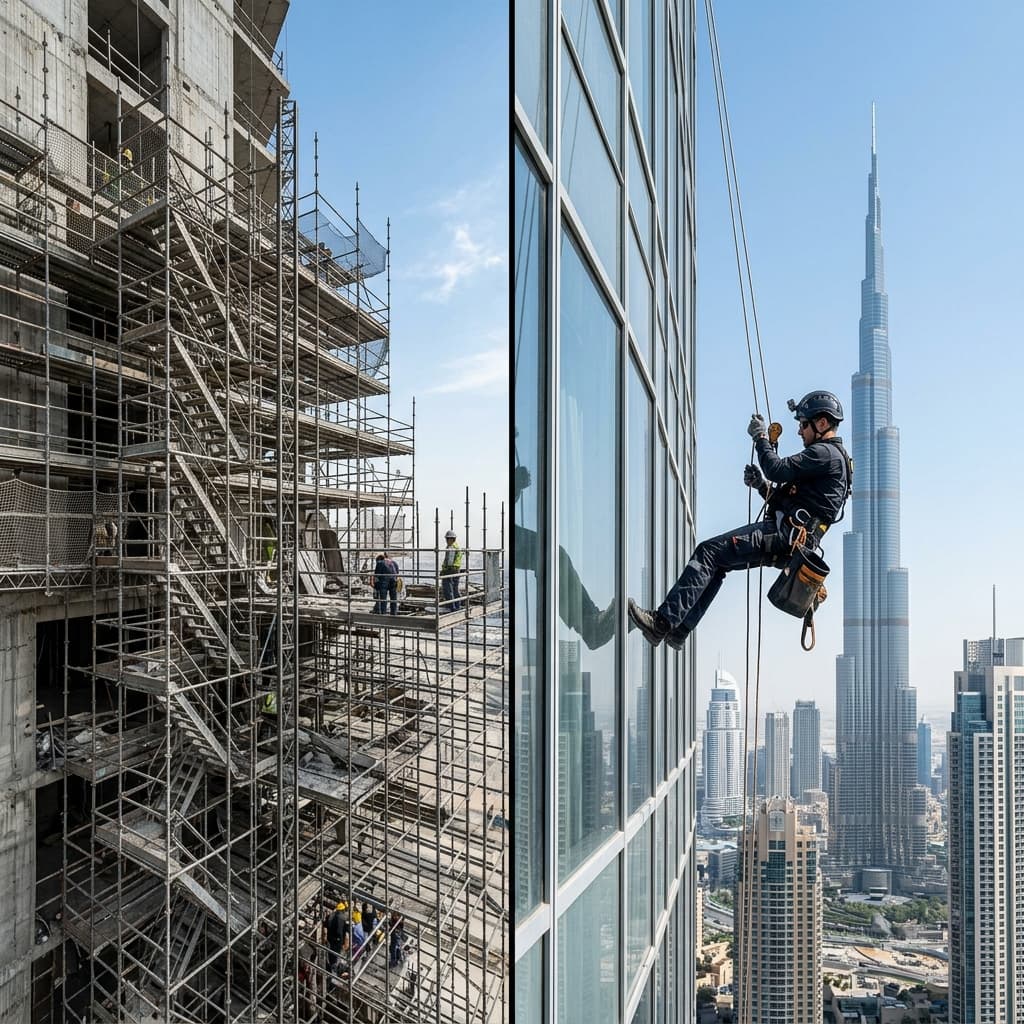
A facilities manager in Business Bay called us last year with a straightforward question: why does a rope access quote for cleaning a 40-story tower come in lower than scaffolding, when scaffolding "feels" like the cheaper option?
It's a fair question. Scaffolding looks simple. Poles, planks, a few weeks of labor. Rope access looks like the expensive, technical choice — harnesses, IRATA technicians, specialized gear.
The math says otherwise, and once you've seen both jobs run side by side, you don't go back.
Start With What Scaffolding Actually Costs
Erecting scaffolding on a high-rise isn't a two-day job. On a 30-plus story building in Dubai, you're looking at 3 to 6 weeks just to put the structure up, and the same again to take it down. That's 6 to 12 weeks where a portion of the building is wrapped in steel before a single window gets cleaned or a single crack gets inspected.
During that window, you're paying for:
Rental fees on the scaffolding itself, which run for the full duration it's standing — not just the days someone's using it. Site access restrictions, because scaffolding blocks entrances, walkways, and sometimes entire floors of usable space. Security and insurance, since a standing structure on a public-facing building is a liability the whole time it's up. Retail and lobby disruption, if the building has ground-floor tenants who lose foot traffic behind a wall of poles for a month and a half.
Add it up and the "cheap" option has been quietly billing you for two months before the actual work even starts.
What Rope Access Changes
A rope access team of 4 to 6 IRATA-certified technicians can complete facade cleaning, window replacement, or inspection work on the same tower in days, not weeks. No structure goes up. No structure comes down. Technicians rig from the roof and access every point on the building directly.
That difference alone is why rope access services in Dubai have become the standard for commercial towers over the past decade, not just a cost-cutting workaround.
The savings aren't only in labor hours. They're in everything scaffolding forces you to pay for around the edges: no rental period stretching across two months, no blocked entrances, no idle structure sitting on your property collecting sand and liability.
Where the Numbers Actually Land
On a mid-rise commercial building (15 to 25 floors), scaffolding-based facade work typically runs 30 to 45 percent higher in total project cost once you factor in rental duration, site disruption, and labor for erection and dismantling. On taller towers, the gap widens, because scaffolding costs scale with height far faster than rope access does — a rope access team's day rate barely changes between floor 20 and floor 60, while scaffolding tonnage and rigging complexity climb fast.
There's also a cost that doesn't show up on an invoice: downtime. A hotel losing rooms to blocked views for six weeks, or a retail tower with scaffolding across its main entrance during a peak leasing season, is paying a cost scaffolding quotes never mention.
When Scaffolding Still Wins
This isn't a case against scaffolding entirely. For ground-level or low-rise work, or jobs requiring heavy materials moved in bulk, scaffolding can still make sense. Rope access earns its cost advantage specifically at height, on vertical facades, where technicians can reach the work directly instead of building a structure to stand on.
If your building is under 6 stories, the comparison changes. Above that, rope access starts winning on cost almost every time.
The Question Worth Asking Your Contractor
Before you approve a scaffolding quote for high-level work, ask for the full timeline: erection, working period, and dismantling. Most quotes only show you the working period cost. Once you see the full number, including the six or eight weeks of standing rental and site disruption on either side, the comparison usually settles itself.
Vertex Plus runs ISO-certified, IRATA Level 3-supervised rope access teams across Dubai and Abu Dhabi. If you're weighing a facade project and want the real numbers side by side, get in touch and we'll walk you through both options for your specific building.
Vertex Editorial Team
Dubai, UAE