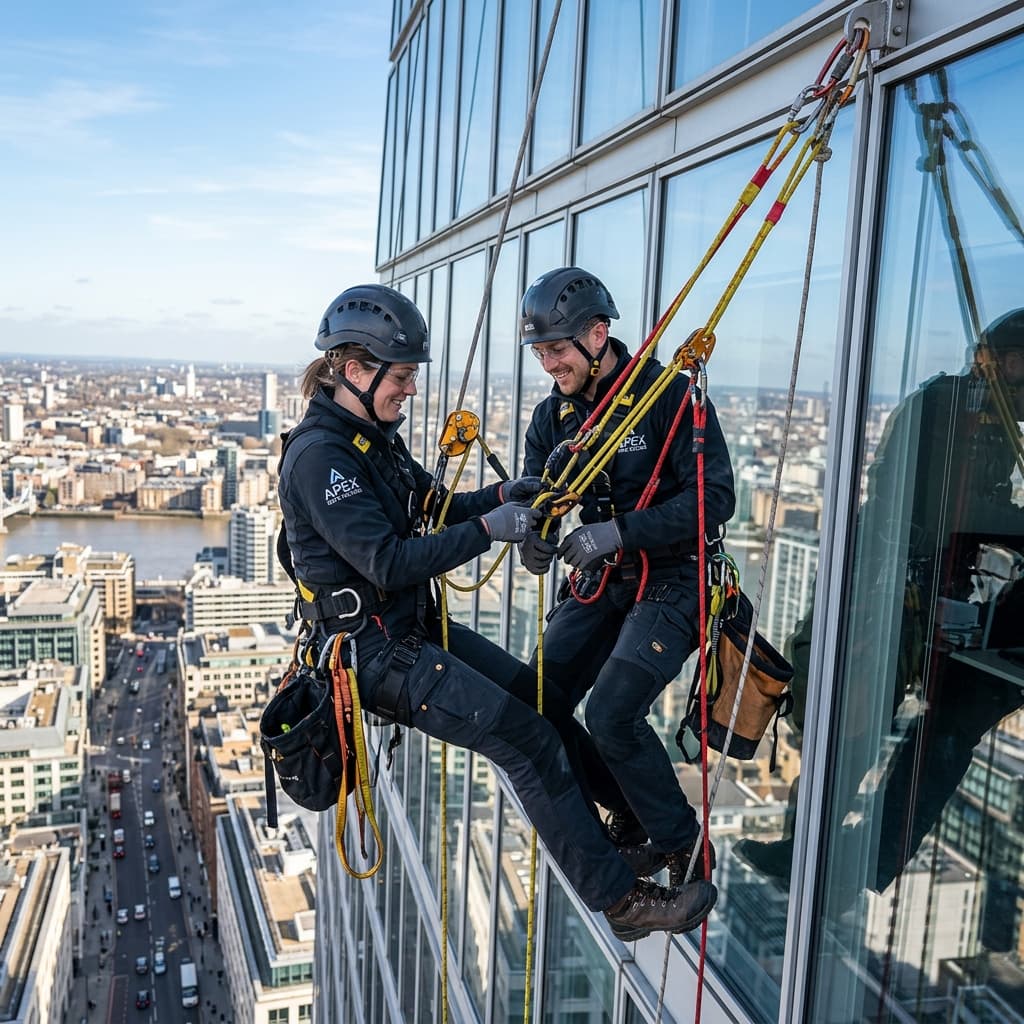
Anyone can put "rope access" on a company profile. Not everyone doing the work is qualified to be dangling four technicians off the side of a 50-story tower.
That gap is exactly why choosing a rope access contractor in Dubai deserves more scrutiny than picking a painting crew or a cleaning service. The work happens at height, on live buildings, often above pedestrians and traffic. If something goes wrong, it doesn't just cost money. So before you sign a contract, here's what's worth checking.
Check the Certification, Not Just the Claim
IRATA (Industrial Rope Access Trade Association) certification comes in three levels. Level 1 technicians can perform basic rope access work under supervision. Level 3 supervisors have logged a minimum of 1,000 hours of rope access work and can run a job site independently, make rescue decisions, and sign off on safety procedures.
A company that says "our team is IRATA certified" without specifying levels is telling you half the story. Ask directly: how many Level 3 supervisors do you have, and will one be on-site for this job? If every technician on the crew is Level 1, there's no one on that rope with the experience to manage an emergency.
Ask About ISO Certification, Not Just Trade Certification
IRATA certifies the technicians. ISO certification (specifically ISO 9001 for quality management, and often ISO 45001 for occupational health and safety) certifies the company's systems — how jobs are planned, how risk assessments get written, how incidents get reported and reviewed. A company can have certified individual climbers and still run a disorganized operation. ISO certification is the check on the business itself, not just the person on the rope.
Request the Risk Assessment and Method Statement Before the Job Starts
Every legitimate rope access project in the UAE should come with a RAMS document specific to your building — not a generic template. It should cover anchor point testing, rescue plan in case of technician injury or equipment failure, weather thresholds for suspending work, and emergency contact procedures. If a contractor can't produce this before work begins, that's the clearest red flag on this list.
Look at Insurance Coverage, Specifically
General liability insurance isn't enough for height work. Ask whether the company carries coverage specific to work-at-height incidents, and get the certificate, not just a verbal confirmation. On a commercial tower, this matters as much to your building's own liability as it does to the contractor's.
Ask How They Handle Confined Spaces and Rescue Scenarios
Rope access sometimes overlaps with confined space entry — inside plant rooms, cooling systems, or structural voids. This requires separate training beyond standard IRATA certification. If your project touches any enclosed or confined area, ask specifically whether the crew has confined space rescue training, not just rope access certification. These are treated as one skill set by some marketing pages and are not the same thing on the job.
References From Buildings Like Yours
A company that's done ten years of villa window cleaning isn't automatically ready for a 40-story commercial tower's facade inspection. Ask for references from projects at a similar height and complexity to yours, and actually call them. A five-minute conversation with a past client's facilities manager tells you more than any brochure.
The Short Version
Before you hire, get four things in writing: IRATA levels of the technicians assigned to your job, ISO certification of the company, a project-specific RAMS document, and proof of work-at-height insurance. Any contractor confident in their operation will hand these over without hesitation. Hesitation is information too.
Vertex Plus is an ISO-certified rope access company operating in Dubai and Abu Dhabi, with IRATA Level 3-supervised teams on every project. If you'd like to see our certifications and RAMS process before you decide, reach out here.
Vertex Editorial Team
Dubai, UAE