
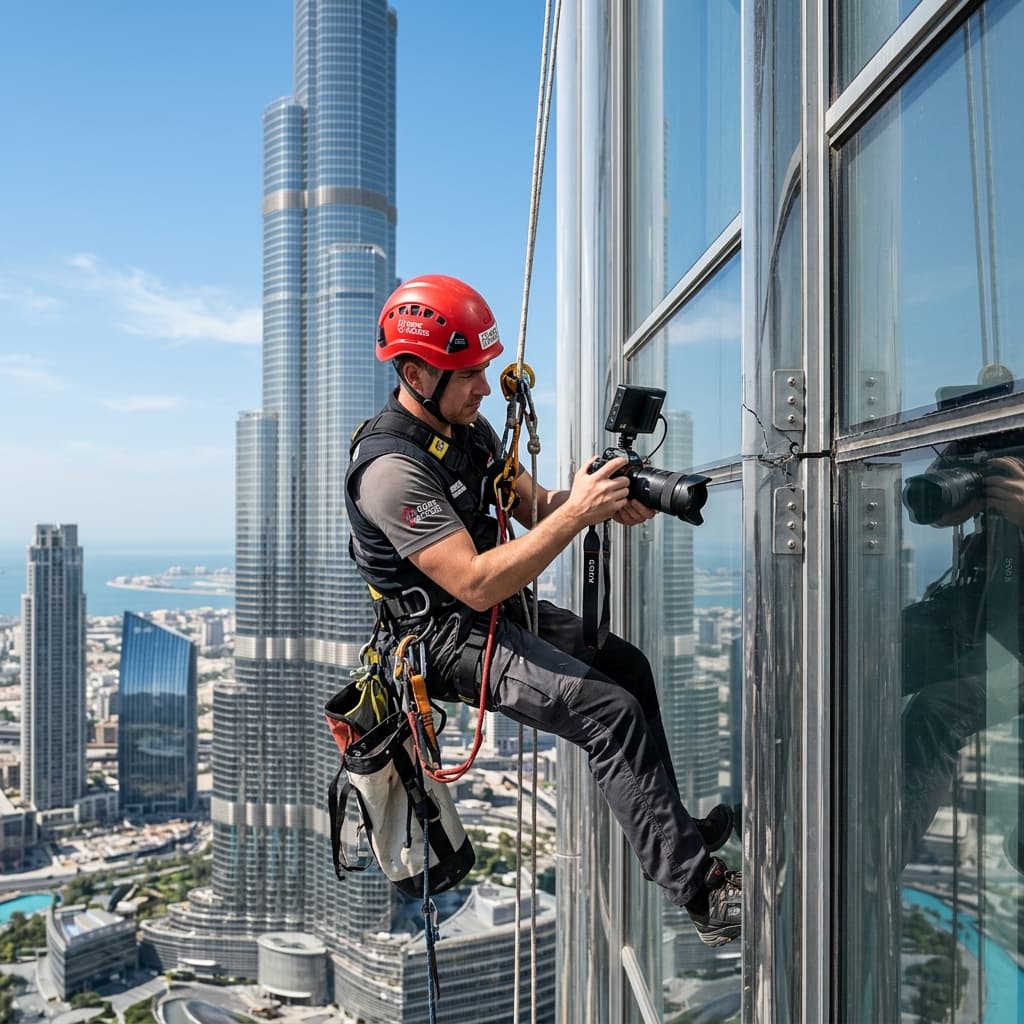
A cracked window seal doesn't look urgent. Neither does a hairline fracture in a facade panel forty floors up. From the ground, both are invisible. That's exactly the problem.
Dubai's climate is brutal on building envelopes in ways that aren't always obvious. Summer surface temperatures on a glass facade can exceed 60°C. That heat expands and contracts materials daily, month after month. Add sandstorms, salt air near the coast, and UV exposure that degrades sealants faster than almost anywhere else in the world, and you get facades that fail quietly, until they don't.
We've inspected buildings across Dubai and Abu Dhabi where a problem invisible from street level turned into an emergency repair once a technician got close enough to see it. Here's what to watch for before that happens to your building.
1. Sealant That's Cracked, Shrunk, or Pulled Away From the Edge
Sealant is the first line of defense against water intrusion, and in Dubai it ages faster than the manufacturer's spec sheet suggests. UV exposure and heat cycling can shrink sealant joints within 5 to 7 years, well before the 10 to 15 year lifespan quoted for milder climates. Once sealant pulls away from a window or panel edge, water finds its way in during the next heavy rain, and by the time you see a stain on an interior wall, the damage is already behind the wall.
2. Discoloration or Staining Around Window Frames
A faint brown or yellow stain streaking down from a window frame is one of the clearest signals of water infiltration. It means moisture is getting behind the facade and interacting with steel framing or insulation. Left alone, this leads to corrosion of structural fixings, which is a far more expensive fix than resealing a joint would have been.
3. Visible Cracks in Glass or Cladding Panels
Thermal stress cracking is common on large glass facades in high-heat climates. A crack that starts as a few centimeters at a panel edge can spread under continued temperature cycling. On cladding panels, cracks often start at fixing points, where the material is under the most stress. Neither type of crack self-heals. Both get worse with every heat cycle.
4. Loose or Vibrating Panels in Wind
If a facade panel makes noise in strong wind, or a technician doing routine cleaning notices movement that shouldn't be there, the fixings behind it may have loosened. This is one of the more serious signs on this list, because a panel detachment on a high-rise isn't just a maintenance cost. It's a safety incident waiting to happen, for the building and for anyone below.
5. It's Been More Than 12 Months Since the Last Inspection
Even with no visible symptoms, Dubai's climate justifies annual building envelope inspections for any high-rise facade. Problems at height are rarely visible from ground level, and by the time a defect is obvious from the street, it's usually been developing for a year or more. An inspection with rope access technicians can reach every point on the facade directly, not just the parts visible with binoculars.
What an Inspection Actually Involves
A proper building envelope inspection isn't a walk-around with a camera from the ground. It means IRATA-certified technicians accessing the facade directly, checking sealant condition joint by joint, testing panel fixings, and photographing any defects for a documented report. That report becomes the basis for prioritizing repairs before small issues become structural ones.
The cost of catching a sealant failure early is a resealing job. The cost of catching it late is water damage, corrosion repair, and in some cases, panel replacement. The gap between those two numbers is usually a single inspection that should have happened a year earlier.
Vertex Plus performs ISO-certified building envelope inspections across Dubai and Abu Dhabi, with full photographic and surface condition reporting. If it's been over a year since your last inspection, or you've noticed any of the signs above, request an inspection before the next sandstorm finds the weak point for you.
Vertex Editorial Team
Dubai, UAE